
A DEXA scan comes again with a T-score beneath -2.5, the physician says the phrase “osteoporosis,” and a marathon aim that felt completely affordable six months in the past immediately feels dangerous.
Most runners who get that prognosis hear two conflicting messages from the individuals round them.
Their physician says shield the bones and keep away from high-impact exercise. Their operating mates say miles are good for bone density and to maintain coaching.
Neither reply is sort of proper.
The peer-reviewed analysis tells a extra particular story.
Working alone doesn’t meaningfully rebuild bone density as soon as osteoporosis has set in, and long-distance runners usually carry decrease bone mineral density than sprinters or power-sport athletes.
Marathon coaching with osteoporosis can nonetheless be an affordable aim, offered quantity, vitamin, and supplemental energy work are constructed round what the bones really want.
So, on this article you’re going to study the research-backed sensible recommendation on marathon coaching with osteoporosis.
- Whether or not coaching for a marathon is protected after an osteoporosis prognosis
- What operating does and doesn’t do to bone density
- Tips on how to construction your coaching week to scale back fracture threat
- The vitamin and energy work that really transfer the bone-density needle
- The precise warning indicators that imply you have to cease and reassess
Can You Safely Practice for a Marathon With Osteoporosis?
For many runners with steady osteoporosis and no historical past of fragility fractures, supervised marathon coaching is cheap.
A 2024 narrative evaluation of masters runners concluded that operating at average volumes doesn’t seem to trigger vital hurt to bone well being in most athletes, offered power availability is satisfactory and energy coaching is included.

The caveat in that sentence issues.
“Secure” means your bone density has been tracked over no less than two DEXA scans, it isn’t quickly declining, and your physician has cleared you for high-impact exercise.
Runners with a latest fragility fracture, a T-score worse than -3.0, lively REDs (low power availability with menstrual or hormonal disruption), or unmanaged medical circumstances that have an effect on bone turnover ought to cease right here and have this dialog with a sports activities drugs physician earlier than registering for a marathon.
For everybody else within the osteopenia-to-mild-osteoporosis vary, the true query isn’t whether or not you may run a marathon.
The actual query is the right way to construction the coaching so the months of affect don’t outpace your bones’ skill to rework.
The choice is about matching coaching load to present bone standing and constructing within the energy, fueling, and restoration assist the bones want.
What Does Working Really Do to Your Bones?
Working impacts bone in two reverse instructions directly.
Impression loading alerts bone cells to put down new tissue, and a 2019 examine of club-level marathon runners discovered that marathoners had larger serum osteocalcin (a bone-formation marker) than age-matched sedentary controls.
That’s the excellent news.
The much less flattering information comes from the broader analysis base.
A evaluation of bone well being in endurance athletes discovered that distance runners usually present decrease bone mineral density than athletes in energy sports activities like leaping, sprinting, or crew sports activities, and in some research decrease BMD than sedentary controls.
Two elements clarify the hole.
Marathon coaching hardly ever produces the height floor response forces that drive the strongest bone-building sign, since simple and steady-state operating sits nicely beneath the affect threshold related to significant BMD good points.
Excessive coaching volumes additionally push runners into low power availability, which blunts bone formation whatever the mileage stacked up throughout the week.
Runners with osteoporosis inherit all of this.
The affect of operating doesn’t routinely make bone worse, nevertheless it doesn’t reliably make it higher both.
Why Lengthy-Distance Working Alone Received’t Rebuild Bone Density
Right here’s the half that surprises most runners.
The strongest proof for rebuilding bone in postmenopausal ladies with osteoporosis doesn’t come from any cardio exercise, together with operating.
The LIFTMOR randomized managed trial confirmed that 8 months of high-intensity resistance and affect coaching elevated lumbar backbone bone mineral density by 2.9% in postmenopausal ladies with osteopenia or osteoporosis, whereas the management group misplaced 1.2% over the identical interval.
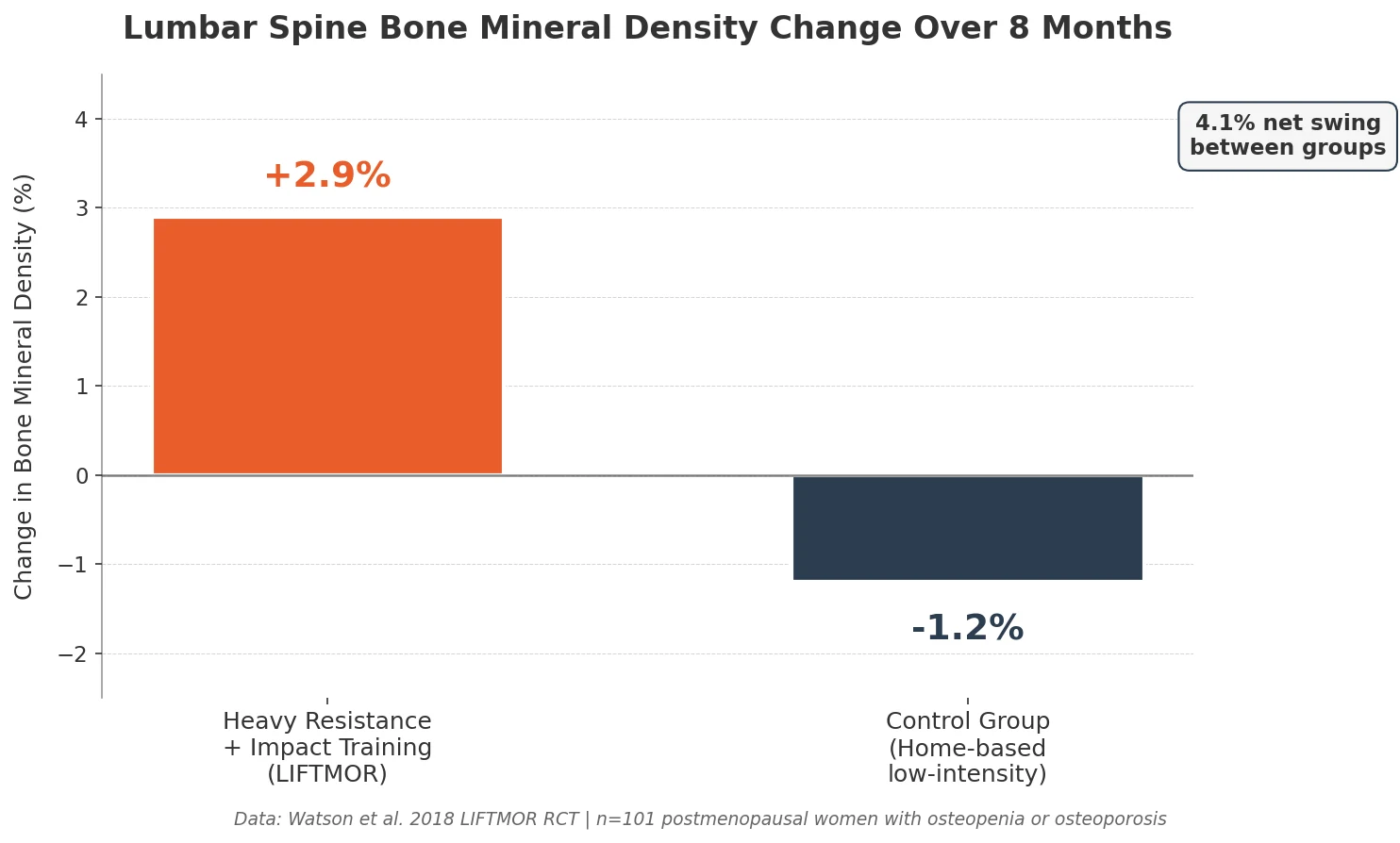
That’s roughly a 4% swing in backbone BMD over eight months, in a inhabitants the place any acquire is unusual.
Femoral neck density and useful energy additionally improved within the intervention group and declined within the management group.
The intervention wasn’t mild.
It was heavy deadlifts, overhead press, again squat at masses above 85% of one-rep max, plus leaping drills utilizing a weighted vest, twice per week, supervised.
The LIFTMOR dose isn’t required for each runner with osteoporosis.
The important thing level is mechanistic: bone adapts to excessive peak pressure, to not accrued submaximal pressure.
A marathon block alone, at coaching paces in zones 2 and three, doesn’t provide that peak sign.
Marathon coaching maintains bones beneath load, however heavy energy and high-impact work are what really rebuild bone density.
Tips on how to Construction a Bone-Protected Marathon Coaching Plan
A bone-aware plan seems to be totally different from a typical marathon plan in 5 particular methods.
Run 4 days per week, not 5 or 6.
Each non-running day is a day the skeleton will get to rework. Dropping from six runs to 4, and filling the hole with energy and low-impact cross-training, reduces cumulative bone stress with out sacrificing the cardio variations that drive marathon efficiency.
Cap your weekly mileage at 40 to 45 miles throughout peak coaching.
Most sub-4-hour first-time marathoners peak between 35 and 50 miles per week.
Staying on the decrease finish of that vary cuts repetitive loading with out compromising race readiness, and longer plans (16 to twenty weeks) permit decrease weekly mileage by spreading the construct.
Run your simple days on softer surfaces when doable.
Grime, crushed gravel, and artificial observe surfaces cut back peak floor response drive in comparison with concrete. Saving roads to your future and one exercise lets the remainder of your week’s miles accumulate on lower-impact terrain.
Do one energy session earlier than simple runs, not after onerous periods.
Heavy lifting on recent legs produces higher mechanical loading and higher bone stimulus than lifting beneath fatigue. E book it the morning of a straightforward day.
Deal with the taper as bone insurance coverage, not simply efficiency prep.
An extended taper (3 weeks as a substitute of two) and earlier discount in long-run distance provides your skeleton restoration time that customary plans don’t schedule.
That is additionally a higher-risk window for stress fracture threat, since runners who really feel recent throughout taper are likely to push tempo on simple runs.
| Coaching Variable | Customary Marathon Plan | Osteoporosis-Adjusted Plan |
|---|---|---|
| Run days per week | 5 to six | 4 |
| Peak weekly mileage | 45 to 60 miles | 40 to 45 miles |
| Floor combine | Largely street | Highway for future and exercises, path or observe for straightforward |
| Energy work | 1 to 2 periods, usually optionally available | 2 periods, heavy load, non-negotiable |
| Taper size | 2 weeks | 3 weeks |
The Diet That Protects Your Bones Throughout Marathon Coaching
Vitality availability is the only greatest vitamin lever for bone well being throughout marathon coaching.
The Worldwide Olympic Committee consensus assertion on Relative Vitality Deficiency in Sport identifies low power availability as a major driver of bone loss in endurance athletes, with mechanisms together with suppressed estrogen, IGF-1, and thyroid hormones that instantly impair bone formation.
Underfueling for even a couple of weeks throughout a marathon construct pushes the physique right into a state the place it may well’t lay down new bone no matter calcium consumption or affect.
Runners with osteoporosis can’t afford any prolonged interval of damaging power stability.
Two targets matter most.
Calcium: 1,200 mg per day
The Institute of Medication recommends 1,200 mg day by day for postmenopausal men and women over 70.
Unfold it throughout the day by way of dairy, fortified plant milks, leafy greens, and almonds, and complement provided that weight loss plan falls brief, since extra supplemental calcium might not ship the identical profit as dietary sources.
Vitamin D: 2,000 IU per day, or titrated to blood degree
Vitamin D permits calcium absorption.
A evaluation of stress fracture prevention in younger athletes discovered that calcium and vitamin D supplementation at 2,000 mg calcium and 800 IU vitamin D decreased tibial stress fracture incidence by 20% in feminine Navy recruits throughout fundamental coaching.
Verify 25(OH)D blood ranges by way of your physician and purpose for 30 to 50 ng/mL.
Protein timing issues for bone reworking.
Protein and calcium stability works collectively, with satisfactory protein (1.2 to 1.6 g/kg for endurance athletes in a marathon block) supporting the collagen matrix that calcium mineralizes.
Sufficient power consumption is the precondition, and calcium and vitamin D solely work if complete power availability is excessive sufficient for bone formation to occur.
Why Energy Coaching Issues Extra Than Miles for Your Bones
If you happen to add one factor to marathon coaching after an osteoporosis prognosis, add heavy energy work.
The LIFTMOR protocol used a selected dose: 5 units of 5 reps at 80 to 85% of one-rep max, on again squat, overhead press, and deadlift, twice per week.
That depth is what drives the height bone pressure operating can’t present.
You don’t want to copy the complete protocol, however the precept holds.
Progressive heavy loading in compound lifts, accomplished twice per week, carries extra bone-building sign than any quantity of simple mileage.
Again squat or goblet squat
Masses the hips and backbone. Begin with body weight or a goblet squat, and progress to a loaded barbell squat beneath a coach’s supervision if doable.
Deadlift
Masses the backbone and hips by way of a hip hinge, which is similar motion sample that protects your decrease again throughout operating. Progress slowly with mild dumbbells earlier than going heavier.
Overhead press
Masses the backbone axially and recruits the higher physique, which distance operating largely bypasses.
Hop and bounce drills
Temporary, multi-directional leaping in the beginning of a session delivers the high-impact sign bone responds to.
5 units of 10 hops, touchdown softly, is an affordable beginning dose for many runners, and you must skip or regress the drill you probably have a latest fracture or a spinal compression concern.
Supervised instruction issues greater than loading quantity.
LIFTMOR’s security file (one minor hostile occasion throughout 101 individuals) got here from skilled supervision, so discover a energy coach with expertise working with osteoporosis earlier than including loaded barbell work.
RunnersConnect Bonus
Obtain your FREE Energy Development slides.
Use these slides to simply create your individual progressive energy routine and adapt your energy work to the part of coaching you’re in.
When to Pull Again or Cease Marathon Coaching
Some warning indicators imply the present plan has exceeded what your bones can take up.
Localized bone ache that worsens with exercise
Ache that sharpens throughout a run and lingers afterward, particularly within the shin, foot, hip, or pelvis, is the basic stress fracture presentation. Cease operating and see a sports activities drugs physician inside 48 hours.
Ache that reveals up at relaxation or at night time
Bone ache that wakes you up or is current if you get off the bed is a pink flag distinct from regular coaching soreness. This requires analysis earlier than your subsequent run.
A brand new fragility fracture
Any bone break from a low-impact occasion (a stumble, a minor fall, a cough) alerts bones weaker than your coaching assumes. Marathon coaching ought to pause till your medical crew reassesses.
A DEXA displaying sooner decline than anticipated
In case your bone density drops greater than 2 to three% between annual scans regardless of the coaching changes, the plan wants rebuilding along with your physician.
Missed or irregular menstrual cycles (for premenopausal ladies)
Menstrual disruption throughout marathon coaching is a symptom of REDs and a direct explanation for accelerated bone loss. It is a medical problem that wants addressing earlier than coaching continues.
None of those indicators finish operating completely.
They imply the subsequent step is a dialog along with your physician or sports activities drugs doctor, not an web search.
Marathon coaching with osteoporosis is viable when the framework stays sincere about what the analysis really helps.