
Our articles are usually not designed to switch medical recommendation. In case you have an damage we advocate seeing a certified well being skilled. For extra data see out Phrases and Situations.
Traditionally, pronation and ‘over-pronation’ have been blamed for nearly all operating accidents in some unspecified time in the future! I even noticed an instance the opposite day the place somebody was advised that over-pronation had induced their neck ache!
This quote from a literature overview by James W. George highlights earlier views;
“It has been estimated that 60% of the grownup inhabitants overpronates to some extent. This overpronation accounts for 60-90% of all foot and decrease extremity accidents categorized as overuse situations (4)”
[Reference 4: Cailliet, R. (1997). Foot and Ankle Pain. F.A. Davis Company: Philadelphia.]
Steadily, the analysis has moved us away from this, particularly a key paper by Neilsen et al. (2014) that studied almost 1,000 runners. Listed below are a few quotes which summarise their findings:
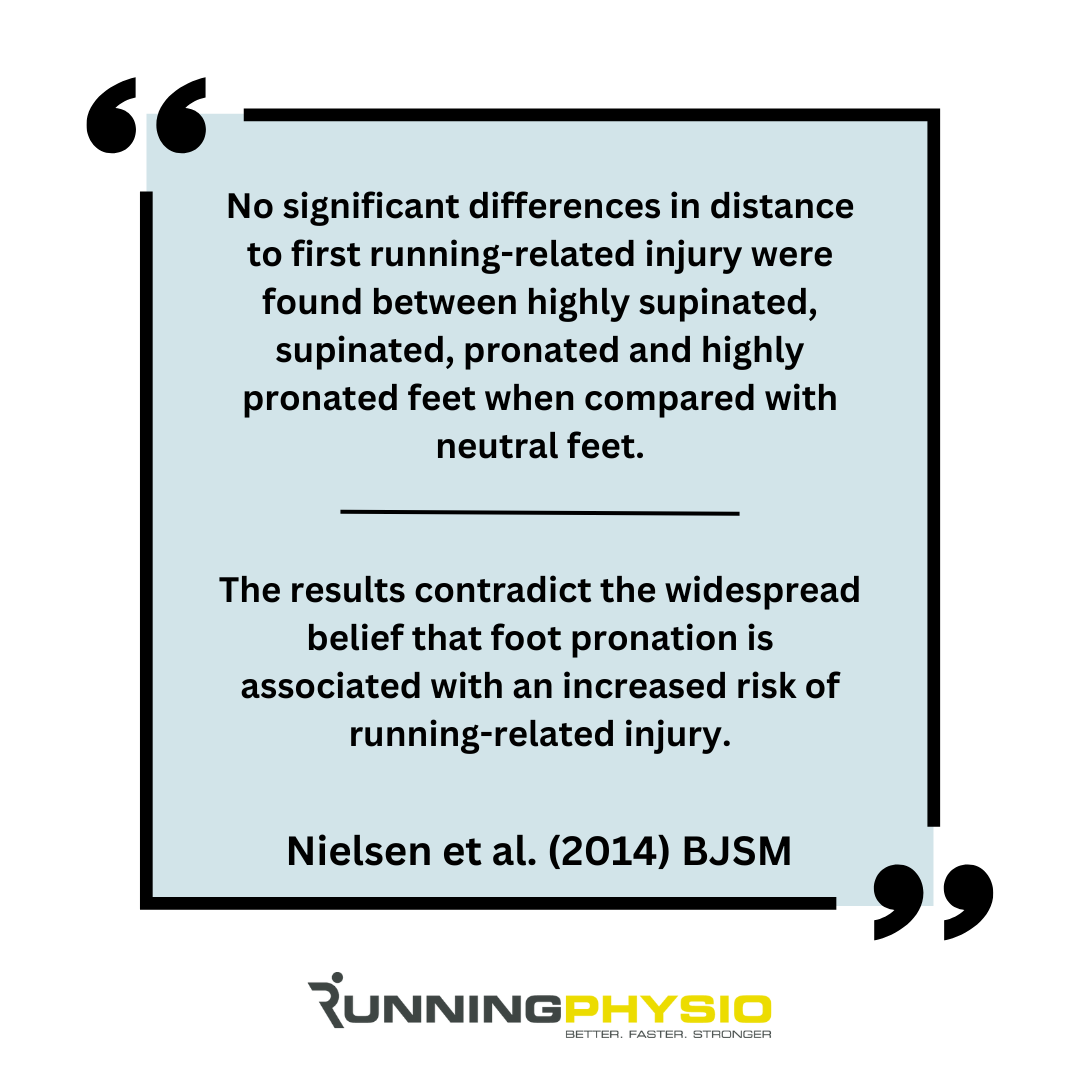
That is pretty typical of concepts in sports activities damage. An idea is vital to the whole lot one second, then thought-about irrelevant the following!
The reality often lies someplace within the center and is usually discovered by making use of our scientific reasoning and the accessible proof to a person’s presentation.
Right this moment’s e mail goes that will help you with this by discussing dynamic evaluation of pronation in runners, the larger image when it comes to gait and potential administration choices (with the instance of PTTD – Posterior Tibial Tendon Dysfunction).
Dynamic evaluation:
There may be worth in evaluation of static foot posture and some proof linking a extra pronated foot sort with Medial Tibial Stress Syndrome and Patellofemoral Ache (Neal et al. 2014).
Nevertheless, this needs to be mixed with dynamic evaluation throughout operating (or different objectives actions) to get the complete image.
Many will deal with the endpoint of pronation when it peaks, which often happens at round mid-stance, however that is solely actually giving us half the data. We additionally have to see the beginning level and assess foot place at preliminary contact.
By assessing begin and finish place, we are able to see the vary of pronation that must be managed on the foot and ankle. This provides us a greater concept of the load tissues that resist this movement (corresponding to Tibialis Posterior) can be uncovered to.

In instance 1 above, I wouldn’t take into account the endpoint at mid-stance to be excessively pronated, however as they land in a reasonably supinated place, I’d nonetheless anticipate vital load on Tibialis Posterior to regulate that movement. Instance 2 above begins in a extra impartial place at preliminary contact however ends barely extra pronated.
Each of those examples are very regular, widespread findings. We don’t have to pathologise pronation! It’s not a fault. We simply take into account the way it may affect load on delicate tissues.
The larger image:
There are 3 key factors to contemplate right here:
- We would be seeing shoe movement quite than foot and ankle movement
- ’Pronation’ could also be a product of different gait elements, corresponding to step width and step charge
- In the case of pronation, we don’t know the way a lot is an excessive amount of!
Level 1 is hard to repair! We may take away the footwear, however which will not precisely symbolize their operating fashion in the event that they habitually put on them to run. It’s a limitation to contemplate.
Level 2 is one thing we are able to doubtlessly change (extra on that in a second). When somebody runs with a slender stride width, they’ll often have extra rearfoot eversion and can usually land in a extra supinated place (particularly if forefoot putting). Word that instance 1 above has a slender stride.
A runner with a low step charge usually has an extended floor contact time, which may additionally permit them to come back into deeper pronation and dorsiflexion ranges at mid-stance.
These findings received’t be captured by static foot evaluation alone.
Pronation is a standard motion that all of us have to some extent. It combines with dorsiflexion and knee flexion to assist us handle load throughout operating. To my data, we’ve no diploma or vary that has been established as ‘over-pronation’. However I imagine that is true of different actions we would attempt to modify, like hip adduction or pelvic drop.
So it comes down to creating a judgment and contemplating may this be inserting extra load on injured tissue. May this be related to their ache? If that’s the case, then we would attempt a change to handle it and see how signs reply.
Administration choices – instance PTTD:
One pathology the place we’d anticipate pronation to be related can be Posterior Tibial Tendon Dysfunction. Tibialis Posterior is a key stabiliser for the arch of the foot, and we’d anticipate extra load on the tendon if it must handle bigger ranges or pronation. Signs are often provoked in deeper dorsiflexion, too, as we expect the tendon is compressed towards the medial malleolus.
With this in thoughts, we could attempt to cut back pronation and/ or dorsiflexion throughout operating to see if that helps signs. There are a number of choices to do that, which might be guided by the affected person’s aggravating elements and response to loading actions:
- Coaching modifications – uphill operating is more likely to improve loading into dorsiflexion, and unstable companies could improve calls for on Tibialis Posterior, so we could recommend lowering or changing some of these coaching if provocative.
- Footwear recommendations – a shoe with a bigger heel-to-toe drop that has medial help and a agency heel counter (to scale back heel movement) could assist cut back load on Tibialis Posterior.
- Train prescription – energy work for Tibialis Posterior and the calf complicated could help in load absorption and encourage tendon adaptation. It could have to be on the proper stage when it comes to signs and energy, and sometimes we’d begin out of pronated/ dorsiflexed positions (e.g. calf increase from the flat)
- Gait re-training – for a runner touchdown in a supinated place and subsequently needing to maneuver by means of a wide range of pronation to convey the foot to the ground, a cue like ‘Run wider’ could assist. Usually, suggestions is required to forestall over-correction, however a barely wider stance often reduces supination at preliminary contact, so there’s much less rearfoot movement. This may help cut back peak pronation, however a second choice can be to extend step charge (if it’s low). It will possibly assist stride width and often reduces floor contact time, so the runner doesn’t transfer into deeper dorsiflexion or pronation positions.
- Orthoses – my choice with orthoses is to discuss with a Podiatrist for his or her knowledgeable enter. They could recommend orthoses with a deep heel cup and heel increase (to scale back dorsiflexion) plus medial longitudinal arch help, and should embody a medial wedge. The purpose isn’t to appropriate a fault however quite to scale back painful loading of Tibialis Posterior. Taping may be an choice to contemplate, with related objectives in thoughts.
PTTD is a posh situation, and its administration relies upon lots on the stage and particular person wants. Our recommendations right here can be for stage 1 PTTD in a affected person tolerating some operating. They might not be acceptable for extra irritable or superior circumstances, corresponding to stage 3 or 4 PTTD with fastened pes planovalgus deformity.
For extra on evaluation and therapy of PTTD and tendinopathy of the foot and ankle see our free Difficult Tendons collection.
