
In a relentless quest to run quicker and additional, we must always not as runners be stunned when now and again issues begin hurting. Efficiency positive factors come from pressured adaption, i.e. your physique will solely adapt in case you pressure it to work via adequate load.
Simply as doing arm curl with a pencil won’t make your biceps any greater, protecting all of your periods on the identical depth won’t aid you run any quicker or additional. Nevertheless, you’ll be able to after all do too a lot (as anybody who has immediately tried curling a 30kg dumbbell will affirm) and analysis confirms that the important thing think about 60-70% of working associated harm is inappropriate coaching load.
When confronted with working associated harm/ache, you will need to bear this share in thoughts. The fundamental legislation of provide & demand signifies that runners are bombarded with an ever growing listing of ‘fixes’ to select from, every being expertly marketed to not simply runners but additionally therapists desperate to be taught the most recent ‘approach.’
Because of this, the most probably supply of a runner’s harm/ache usually will get misplaced inside a sea of reasoning that will nicely sound very spectacular however in actuality lacks any type of proof based mostly rationale. Evidently, if incorrect assumptions are made relating to the supply of an harm/ache, it is vitally doubtless that the therapy prescribed can be flawed.
This text goals to supply runners (and therapists) with a primary guidelines to work via with the intention to guarantee that the most probably reason for harm/ache shouldn’t be missed, that means you’ll hopefully get again on observe sooner slightly than later.
[addtoany]
Proof Pyramid
Within the diagram under, I’ve introduced potential causes of working associated harm so as of proof. In different phrases, the underside a part of the pyramid represents elements & interventions which might be most supported by proof, while the highest of the pyramid represents these with the least proof. Let’s check out them one after the other.
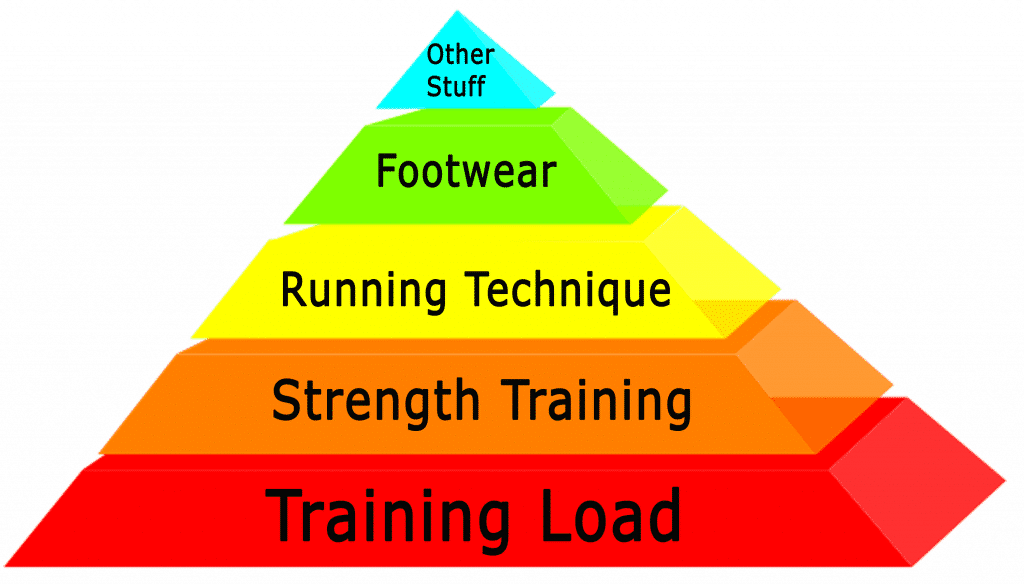
Coaching Load
As acknowledged within the introduction, analysis reveals that the important thing think about 60-70% of working associated harm is inappropriate coaching load (Hreljac et al. 2004: Influence & Overuse Accidents in Runners). By inappropriate load we’re speaking a couple of sudden enhance in both working frequency (runs per week or day), depth (pace, incline, and so on.) or distance (time on ft).
Although your physique is a grasp at adapting to new demand, tissue & system thresholds are put in place to guard you from doing your self critical hurt. For those who immediately exceed these thresholds you’re very more likely to expertise ache and/or harm.
Retaining a coaching diary of what you don’t simply every week but additionally over months and even years could be a wonderful manner of monitoring load and avoiding sudden jumps.
You’ll discover all through this text that I make a degree of separating ‘ache’ and ‘harm’. The excellence is necessary as they’re not the identical factor.
Ache is a warning message from the mind that based mostly on the sensory info it continually receives it appears to be like like hazard is imminent. It’s a defence mechanism, an alarm; precise tissue injury could not have occurred but as it might be fairly ineffective warning system if the alarm solely went off after injury had occurred.
[bctt tweet=”Pain is a warning message from the brain @Runners_Connect” via=”no”]
Ache and precise tissue injury can clearly happen on the identical time nevertheless it’s not a prerequisite, and the way a lot ache you’re feeling shouldn’t be an correct measurement of how a lot tissue injury has been (if any).
It’s necessary to recollect this when assessing why your physique is hurting. Analysis reveals that fearing or worrying about critical structural harm can enhance ache (e.g. seeing graphic photos or disturbing metaphors like ‘put on & tear’ or ‘degeneration’), simply as understanding ache and realising that issues can harm so much even when there’s not critical tissue injury (e.g. a paper reduce) can cut back ache.
[addtoany]
That is not to say that ache is all in your head or imaginary – all ache is very actual. It simply signifies that when making an attempt to get well from ache we have to bear in mind that there’s at all times a mind concerned, not simply an uncomfortable physique half. Focussing solely on ‘fixing’ the physique half dangers lacking out an necessary a part of the restoration technique.
For extra info, please learn An Introduction To Understanding Ache).
Power Coaching
If inappropriate coaching load is a key think about working associated harm, it is smart that getting stronger so you’ll be able to deal with extra load can be a great way of lowering danger of harm. And the analysis helps this: research present that energy coaching can cut back sports activities accidents to lower than 1/3 and overuse accidents by virtually 50% (Lauersen et al. 2013: The Effectiveness of Train to Forestall Sports activities Accidents).
As I’ve talked about many instances in different articles, runners usually get manner too obsessed by stretching, actually because therapists nonetheless too usually erroneously prescribe stretching as a treatment for harm/ache. Operating doesn’t require far more flexibility that strolling.
How is a stretch that places you able you’ll by no means use while working going that will help you? You aren’t a dancer, you aren’t a martial artist, you’re a runner. The 2013 Laursen research talked about above discovered no correlation between stretching and harm prevention. Aside from feeling good, stretching in all probability does little or no that will help you cut back harm, run quicker or additional. In actual fact, an excessive amount of flexibility can really cut back efficiency and enhance danger of harm.
[bctt tweet=”Too much flexibility can actually increase risk of injury @Runners_Connect” via=”no”]
When assessing the reason for harm/ache, checking energy is crucial. Operating is basically a collection of hops from one leg to the opposite, and the flexibility of the muscular tissues/tendons to supply propulsion depends on them having adequate ‘spring’. Each time we land throughout working, our muscular tissues/tendons retailer ‘elastic power’ from the bottom after which use it for propulsion.
[addtoany]
This idea of a lengthening of the muscle-tendon unit adopted by a shortening is known as the Stretch-Shortening Cycle (SSC) and requires us to have ‘stiff’ springs, i.e. extra like a Pogo Stick slightly than a Slinky. Attempting to extend coaching load with out having adequate energy will most probably result in harm/ache.
For extra info, please learn Why Bettering Calf Power and Checking Mobility Can Enhance Efficiency)
Operating Approach
We’ve checked coaching habits, we’ve checked energy, what’s subsequent? Effectively, how you run will clearly have an effect on what components of your physique are put beneath stress. If we outline ache/harm as signal that the load threshold of a sure tissue has been exceeded, checking your working type could be a very helpful manner of both looking for the supply of the problem or perhaps discovering another manner of working while you get well.
Now we have already talked about that ache is not only a product of tissue injury. How a lot ache you’re feeling and certainly whether or not you’re feeling it in any respect relies on many sorts of sensory suggestions. Tweaking your working type so that you could expertise ache free working could be a good way of serving to the nervous system get well.
Sadly, many gait analyses spend too lengthy on the lookout for biomechanical flaws or making an attempt to infer what footwear could be greatest for you. Each of those areas are very gray in terms of analysis, and a whole lot of the respective info introduced to runners throughout gait evaluation is unfounded (particularly in footwear prescription).
For extra info, pleaser learn 3 Causes a Gait Evaluation at a Operating Retailer Might Not Assist You Discover the Proper Shoe and take heed to our podcast The Significance Of A Full Physique Gait Evaluation).
Footwear
We’re getting in direction of the highest of the pyramid, which suggests proof is getting scarce. Common readers can be conscious that basing shoe choice on how a lot you ‘pronate’ (a wonderfully pure and very important a part of foot mechanics) is not backed by any science.
Although some runners sporting an ‘anti-pronation’ shoe might even see ache disappear, others don’t, and a few see signs worsen. Analysis has clearly proven that categorising runners into three teams based mostly on their foot arch (excessive/regular/low) ignores pure human variance.
Now that stated, we do know that completely different footwear (and insoles) will load tissues in another way; it’s only a query of figuring out what works for your physique. Modifying footwear can be a helpful manner of resting sensitised tissues and permitting restoration however so far as selecting which shoe is greatest for you, gait evaluation will hardly ever present the solutions.
[addtoany]
Different Stuff
Now we have reached the highest of the pyramid. Regardless of this being the smallest half when it comes to proof, it’s sadly a spot the place many runners (and therapists) spend manner an excessive amount of time. This may increasingly nicely assist clarify why the incidence of working associated harm shouldn’t be on the lower.
[bctt tweet=”The ultimate injury guide everyone needs to read @Runners_Connect” via=”no”]
Something we haven’t talked about but sits right here: stretching, foam rolling, kinesiology tape, acupuncture, and so on. I’m not saying these are all a waste of time however so far as working associated harm goes they’re the least supported by proof.
There’ll at all times be runners who swear by them after all however anecdotal proof doesn’t actually matter for a lot. Simply since you do certainly one of these for six weeks after which see your ache disappear doesn’t imply that what you probably did was the answer. How are you aware it wasn’t the pure therapeutic technique of the physique that precipitated the ache to go, or the very fact you haven’t been working for six weeks?
Devoting an excessive amount of time on the prime of the pyramid dangers lacking out on proof based mostly causes & options on the backside, which may lead to you staying injured and/or in ache for an pointless very long time.
When Ought to You See a Physician A couple of Operating Damage?
Working via the pyramid guidelines above is the correct start line for many working ache, however sure signs require a sports activities physiotherapist, sports activities drugs physician, or orthopedic specialist straight away.
See a healthcare skilled in case you discover any of those red-flag indicators:
- Sharp, localized bone ache that worsens with each footstrike: a potential signal of bone stress harm
- Vital swelling that doesn’t cut back inside 48 hours
- Numbness, tingling, or weak spot within the foot or decrease leg throughout or after working
- A sudden sharp pop adopted by rapid ache and lack of perform
- Ache that reveals no enchancment in any respect after two full weeks of decreased coaching load
Bone stress accidents require specific warning: signs alone should not sufficient for a prognosis, and imaging is required.
Persevering with to coach via bone stress with no confirmed prognosis dangers full fracture.
A scientific assessment of bone stress accidents in long-distance runners discovered the tibia accounts for roughly 50% of all circumstances, with signs usually mimicking soft-tissue accidents for weeks earlier than a prognosis is confirmed.

In case your signs don’t embrace a pink flag however ache has lingered past three weeks regardless of lowering load, a physiotherapy evaluation continues to be the correct name.
physio will work via precisely the identical guidelines this text describes: evaluating coaching load, energy, and working type.
They are going to usually determine a contributing issue you would not spot by yourself.
If you wish to help tissue restore within the meantime, RC’s information on the perfect meals for therapeutic while you’re injured covers the proof on restoration vitamin.
In search of skilled assist shouldn’t be a failure of self-management.
It’s what the evidence-based backside of the pyramid recommends when the fundamentals haven’t resolved the issue inside an inexpensive timeframe.
RunnersConnect Bonus
Obtain your FREE Damage Evaluation and Prediction Video now.
harm prevention program begins with assessing the place you’re weak and the place you may be tight or inhibited. Within the video I’ll reveal the six mobility exams it’s good to carry out to evaluate what it’s good to start engaged on.
How Do You Return to Operating After an Damage?
Getting again too rapidly is the commonest motive a resolved harm turns right into a persistent one.
The core rule of returning is matching your load enhance to what the therapeutic tissue can tolerate, to not what your health stage suggests you must deal with.
Analysis on coaching load administration has constantly discovered that athletes who enhance weekly load by greater than 10% face considerably greater harm danger than those that progress conservatively, a discovering that applies equally to coming back from harm because it does to constructing a coaching block.
A dependable methodology for guiding your return is ache monitoring: charge your ache on a 0-10 scale earlier than, throughout, and two hours after every run.
Ache of three or under throughout a session is usually acceptable, with tissue being loaded with out being pushed previous its threshold.
Ache above 5 throughout a run, or ache that is still elevated two hours after ending, is a sign to chop your subsequent session by 30-50%.
Ache that returns to 0 inside two hours of ending is a inexperienced mild to take care of your deliberate development the next day.
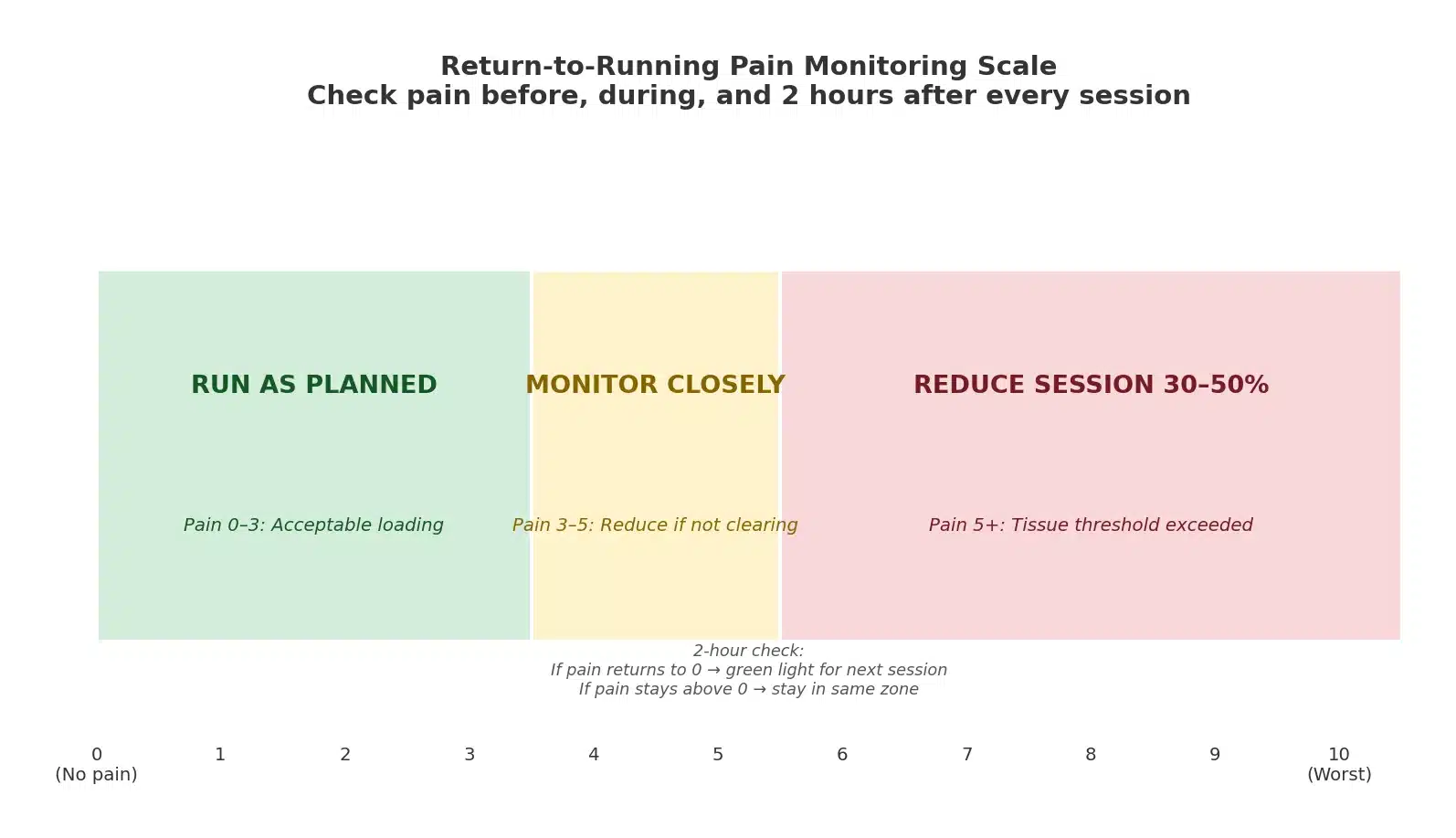
Cross-training performs a key position within the early return part.
Pool working and biking allow you to preserve cardiovascular health with out the bottom response forces that careworn the injured tissue.
A helpful rule of thumb: for each week you spent unable to run, anticipate one week of cautious re-introduction earlier than returning to full coaching quantity.
For an in depth step-by-step framework on how you can construction this course of, learn RC’s full information on how you can return to working after an harm.
In Abstract
Therapy of working associated harm shouldn’t be black & white. Analysis has but to supply us with solutions as to why some runners get injured and others don’t. This may be vastly irritating for the runner who simply desires to get again on the market, as recommendation can range significantly relying what you learn or who you converse to.
Because of this, is it very important to examine for the most probably causes of working associated harm/ache initially, to make use of what high quality analysis