
You cross the marathon end line feeling robust, wave on the crowd, and eat your celebratory bagel.
Two days later, you get up with a sore throat and a fever.
Your first intuition is responsible the race.
Your second is to fret you probably did one thing unsuitable together with your coaching.
Your third is to determine why this occurs to so many runners.
Publish-race illness is actual.
It’s not an indication of weak spot or poor health.
It’s a predictable immune response to excessive train, and your physique’s response to a marathon is documented and measurable.
So, on this article you’re going to study the research-backed sensible recommendation on: runner’s flu and learn how to forestall it.
- What runner’s flu truly is and why the “open window” is actual physiology
- How frequent post-race illness is amongst marathoners
- Why your immune system crashes after intense train
- Once you’re most susceptible and the way lengthy that window lasts
- Which components improve your an infection threat essentially the most
- Proof-based prevention methods that truly work
- The best way to get well sooner if you happen to do get sick
What Is Runner’s Flu and Why Does It Occur?
Runner’s flu shouldn’t be precise influenza.
It’s a brief vulnerability to higher respiratory tract infections (URTI) that seems within the days following intense endurance train, significantly marathons.
This vulnerability exists as a result of your immune system quickly suppresses its defenses after excessive effort.
The window of suppression usually lasts 24 to 72 hours post-race.
Analysis has proven that runners have considerably increased threat of higher respiratory tract an infection inside 1-2 weeks following marathon completion.
This phenomenon is named the “open window” principle of train immunology.
The time period describes a particular interval when your physique is extra vulnerable to pathogenic invasion as a result of your immune cells are recovering and your mucosal boundaries are quickly weakened.
The open window shouldn’t be a delusion or a nocebo impact.
It’s measurable immunology backed by many years of peer-reviewed analysis on train physiology.
Publish-race illness is a predictable facet impact of pushing your physique to its limits, not a failure of your immune system.
How Frequent Is Publish-Race Illness Amongst Runners?
Between 30 and 60 % of marathon individuals expertise higher respiratory tract an infection signs inside 1-2 weeks of race completion.
This excessive prevalence seems persistently throughout research of leisure and aggressive marathoners.
Your probabilities of getting sick are nearer to 1 in 3 fairly than 1 in 10 or 1 in 5.
Psychological stress and sleep loss amplify this baseline threat.
Runners who sleep poorly within the week earlier than the race or who report excessive pre-race anxiousness have considerably increased an infection charges than those that sleep effectively and handle stress.
Age additionally issues.
Older runners (55+) present decrease an infection charges than youthful ones, doubtless as a result of their pre-race coaching stress is decrease.
In the event you obtained sick after a marathon, you’re statistically within the majority, not an outlier.
Why Does Your Immune System Drop After a Marathon?
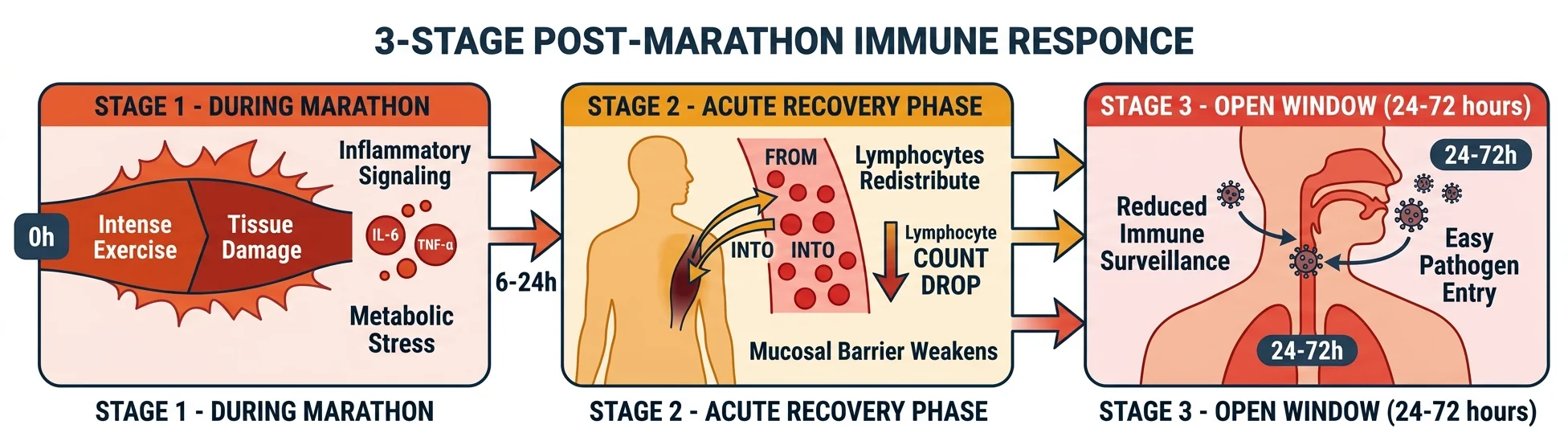
Throughout a marathon, your physique produces large quantities of inflammatory signaling molecules referred to as cytokines, significantly interleukin-6 (IL-6) and tumor necrosis factor-alpha (TNF-α).
These cytokines set off an acute inflammatory response that mobilizes immune cells to handle the tissue injury and metabolic stress of the race.
Within the hours instantly after the race, your circulating immune cells (significantly lymphocytes) drop sharply as they redistribute from the bloodstream into broken muscle tissue and different affected areas.
This redistribution creates the vulnerability.
Your higher respiratory tract loses circulating immune surveillance exactly when pathogens have the most effective probability of invading, as a result of the mucosal barrier additionally weakens quickly.
The mechanism shouldn’t be damaged immunity.
It’s recovery-phase immunosuppression.
Your immune system shouldn’t be weak.
It’s redirecting assets towards tissue restore and adaptation.
That redirection leaves a brief hole in your defenses towards incoming pathogens.
This is the reason managing stress earlier than a marathon is protecting.
Decrease pre-race cortisol means much less inflammatory cascade post-race, which suggests sooner immune restoration and a shorter vulnerability window.
Your immune system response to train is measurable and reproducible throughout 1000’s of athletes.
That is textbook immunology, not a person weak spot.
The sicker you get post-race, the higher your endurance health, as a result of solely maximum-effort races set off the profound immune redistribution that creates vulnerability.
How Lengthy Does Your Immune System Keep Suppressed After a Race?
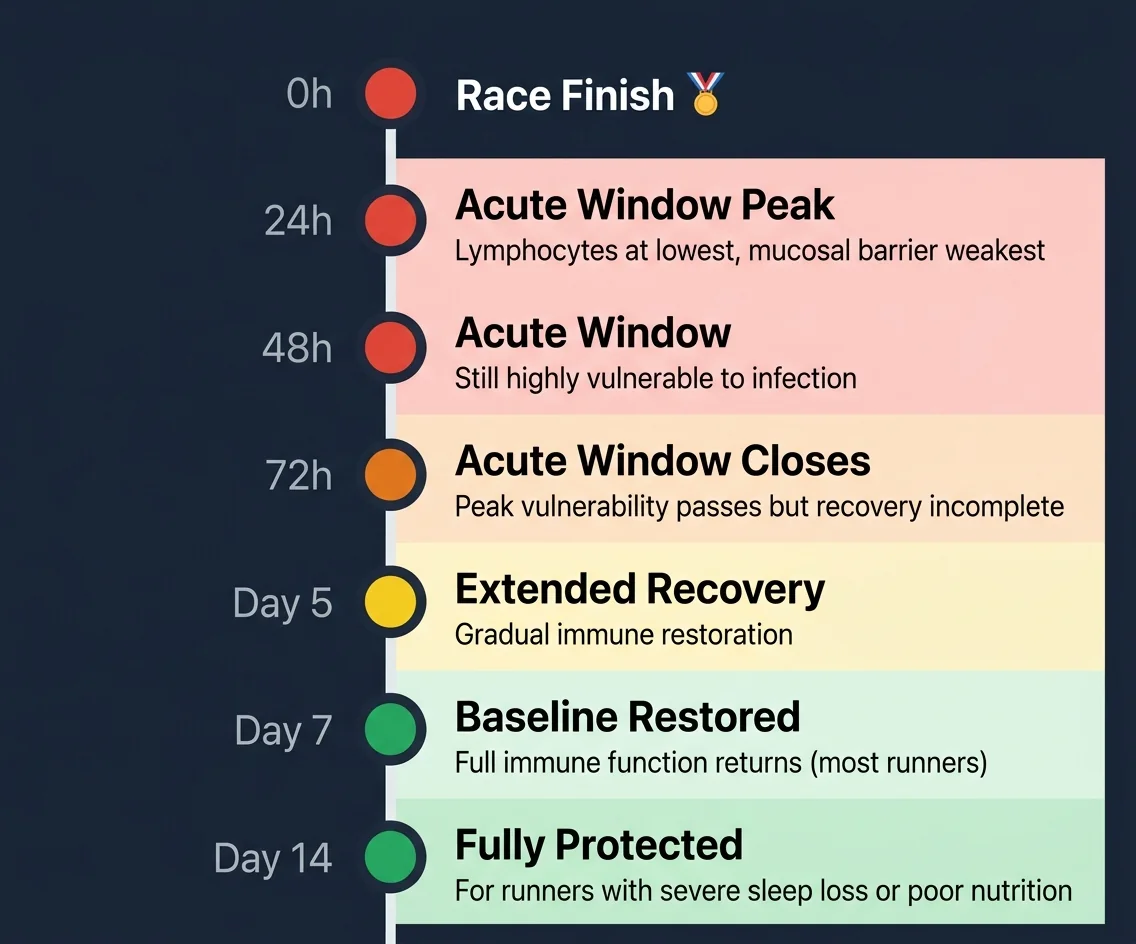
The acute open window is the interval of biggest vulnerability, lasting between 24 and 72 hours post-race.
That is when your lymphocyte counts are lowest.
Your mucosal IgA (the antibody defending your higher respiratory tract) is most depleted.
Pathogenic invaders have the simplest entry level throughout this window.
Nonetheless, your immune system doesn’t snap again to baseline after 72 hours.
Restoration is gradual, with full restoration of pre-race immune perform taking 5 to 7 days for many runners.
In the event you skilled extreme sleep loss or poor vitamin throughout race week and restoration, restoration can take as much as 2 weeks.
This prolonged timeline explains why many runners get sick days after the race fairly than the day after.
They encounter a virus on day 3 or 4 however suppose they’ve cleared the hazard zone.
Then they develop signs on day 5 or 6 once they’re already coaching once more.
The 72-hour window is the height, however your immune vulnerability extends throughout your complete first week of restoration.
What Elements Enhance Your Threat of Publish-Race Illness?
The open window exists for each marathoner, however not all vulnerabilities are equal.
A number of components decide whether or not you get sick or keep wholesome throughout that essential restoration interval.
Sleep deprivation earlier than the race. Runners who common lower than 6 hours per evening within the week earlier than a marathon have 3-4 instances increased an infection charges than these sleeping 7-9 hours nightly.
Sleep loss amplifies the inflammatory cascade post-race and slows immune cell restoration.
A single good evening’s sleep earlier than the race can’t undo per week of poor sleep, however prioritizing sleep 2-3 weeks earlier than race day measurably protects your immune system.
Excessive pre-race anxiousness. Psychological stress elevates cortisol, which immediately suppresses immune cell perform and prolongs the inflammatory response post-race.
Runners who report excessive anxiousness within the week earlier than a marathon present wider and extra extreme open home windows.
Poor post-race vitamin. Your immune cells restore and multiply utilizing amino acids and glucose.
In the event you don’t eat inside 1-2 hours after ending, you miss the essential window for refueling the immune restoration course of.
Continued laborious coaching instantly post-race. Runners who don’t take 3-5 days of simple effort or full relaxation after a marathon prolong their immunosuppression.
Further coaching stress prevents immune cell restoration.
Crowd publicity and hygiene. Marathons imply race expos, end traces, and celebration gatherings all with high-pathogen-density environments.
Touching your face throughout these 24-72 hours post-race dramatically will increase an infection threat.
Dehydration and electrolyte depletion. Extreme dehydration impairs immune cell perform and delays restoration of mucosal boundaries.
This is the reason post-race hydration and electrolyte substitute matter as a lot as carbohydrate and protein.
Sleep, vitamin, stress administration, and restoration days matter greater than genetics in figuring out whether or not you get sick post-race.
The best way to Stop Publish-Race Illness: Proof-Based mostly Methods
You may’t remove the open window as a result of it’s a crucial a part of the restoration course of after excessive effort.
However you may shrink it, and you may handle your conduct throughout these susceptible days to dramatically cut back an infection threat.
Sleep 7-9 hours nightly beginning 2-3 weeks earlier than the race. That is the one most protecting intervention towards post-race illness.
Constant sleep high quality builds immune reserves that persist by race week and speed up post-race immune restoration.
Handle pre-race anxiousness by evidence-backed practices. Meditation, structured respiratory (4-7-8 respiratory), journaling, or teaching conversations together with your coaching accomplice cut back cortisol elevation within the days earlier than the race.
These practices measurably shorten your post-race vulnerability window.
Eat a post-race restoration meal inside 1-2 hours of ending. Carbohydrates plus protein plus electrolytes in that window replenish glycogen shops.
They supply the amino acids your immune system wants for cell restore and multiplication.
Restoration vitamin targets: 40-60 grams of carbohydrates, 15-25 grams of protein, and 300-500mg sodium inside 60 minutes of ending.
This doesn’t must be a proper complement.
Actual meals (sandwich, chocolate milk, pasta with sauce) works simply as effectively.
Take 3-5 days of simple or full restoration after the race. Your marathon restoration plan ought to embody zero laborious efforts for the primary 3-5 days.
This offers your immune cells time to get well with out the extra metabolic stress of coaching.
Restrict crowd publicity for the primary 48-72 hours post-race. Skip the post-race social gathering.
Keep away from touching high-contact surfaces and your face.
Hand hygiene issues extra throughout this window than at some other time in your coaching.
Hydrate aggressively for 24-48 hours post-race. Rehydrate to 150% of the physique weight misplaced throughout the race over the 4-6 hours post-finish.
This accelerates immune restoration and restores mucosal barrier perform.
The strongest predictor of staying wholesome post-race is whether or not you are taking true restoration days, not whether or not you purchase particular dietary supplements.
Can Dietary supplements or Nutritional vitamins Stop Runner’s Flu?
Runners usually ask whether or not vitamin C, zinc, probiotics, or different dietary supplements can forestall post-race illness.
The analysis is combined, which suggests the sensible advice is obvious: deal with fundamentals first.
Vitamin C. The assumption that megadoses of vitamin C forestall colds dates again to a 1970 declare that has by no means been replicated.
A Cochrane overview of 29 trials discovered no profit from supplemental vitamin C for lowering chilly incidence within the common inhabitants, together with bodily energetic people.
Zinc. Some proof means that supplemental zinc (15-30mg each day) taken throughout heavy coaching blocks and within the week earlier than a race might modestly cut back an infection period if you happen to do get sick.
Prevention is unclear.
Probiotics. Probiotics are standard however proof is restricted.
Just a few research present particular strains might modestly cut back an infection charges in runners, however the impact is small.
Most probiotic dietary supplements lack the particular strains utilized in these research.
Immunoglobulins and IgA-boosting dietary supplements. These are rising interventions with fascinating mechanistic rationale as a result of they immediately handle mucosal barrier perform.
Present research are small, however early knowledge recommend potential for specialised formulations in future analysis.
Save your cash on dietary supplements and deal with sleep, vitamin, stress administration, and restoration days first.
The best way to Get better Quicker If You Do Get Sick
Regardless of your greatest prevention efforts, you may nonetheless get sick.
In the event you do, a number of methods can shorten sickness period and cut back severity.
Relaxation fully for the primary 3-5 days of signs. Coaching whereas sick extends irritation and delays immune restoration.
The illness is telling you that your immune system is working laborious.
Assist it by eradicating further stress.
Eat satisfactory protein and carbohydrates.
Your immune system wants uncooked supplies to struggle an infection.
Purpose for 1.2-1.6g protein per kilogram of physique weight each day throughout sickness.
Preserve carbohydrate consumption to help immune cell vitality calls for and stop further metabolic stress.
Sleep as a lot as potential. Sleep is when immune cells proliferate and cytokine steadiness restores.
Prioritize 9-10 hours nightly if you happen to’re sick.
Rehydrate and replenish electrolytes. Fever and congestion improve fluid loss.
Drink water persistently, not simply when thirsty.
Embody electrolytes (sodium, potassium) as a result of immune cell perform relies on correct electrolyte steadiness.
Return to coaching conservatively. Resume operating solely when signs resolve.
Begin with simple 20-30 minute efforts.
Wait no less than 1 week earlier than resuming any laborious efforts or lengthy runs.
Look ahead to warning indicators. If fever persists past 5-7 days, if you happen to develop chest ache or shortness of breath, or if signs worsen after initially bettering, contact a physician.
Most circumstances are viral and resolve on their very own, however bacterial an infection or viral problems warrant medical consideration.
Sick runners who relaxation get well sooner than those that prepare by sickness.
Runner’s flu is post-race higher respiratory an infection brought on by short-term immune suppression after marathon effort, generally known as the “open window.”
Between 30 and 60 % of marathon runners expertise sickness inside 1-2 weeks of racing, with vulnerability highest within the first 72 hours and regularly recovering over 5-7 days.
Your immune system doesn’t fail after a marathon. It redirects assets from an infection protection to tissue restore, leaving your higher respiratory tract quickly susceptible to pathogens.
Sleep deprivation earlier than the race, excessive pre-race anxiousness, poor post-race vitamin, and skipped restoration days are the first modifiable threat components.
Prevention focuses on sleep (7-9 hours nightly 2-3 weeks pre-race), pre-race stress administration, post-race vitamin (inside 1-2 hours), 3-5 restoration days, and limiting crowd publicity throughout the first 72 hours.
In the event you get sick, relaxation fully, eat satisfactory protein and carbohydrates, sleep 9-10 hours nightly, keep hydrated with electrolytes, and delay return to coaching till signs resolve.
Dietary supplements like vitamin C present no profit, and zinc and probiotics have restricted proof.
Give attention to sleep, vitamin, stress, and restoration earlier than contemplating dietary supplements.
Probably the most predictive think about staying wholesome after a marathon is whether or not you truly take restoration days, not your genetics or coaching quantity.