
This entry was posted on Nov 19, 2025 by Charlotte Bell.
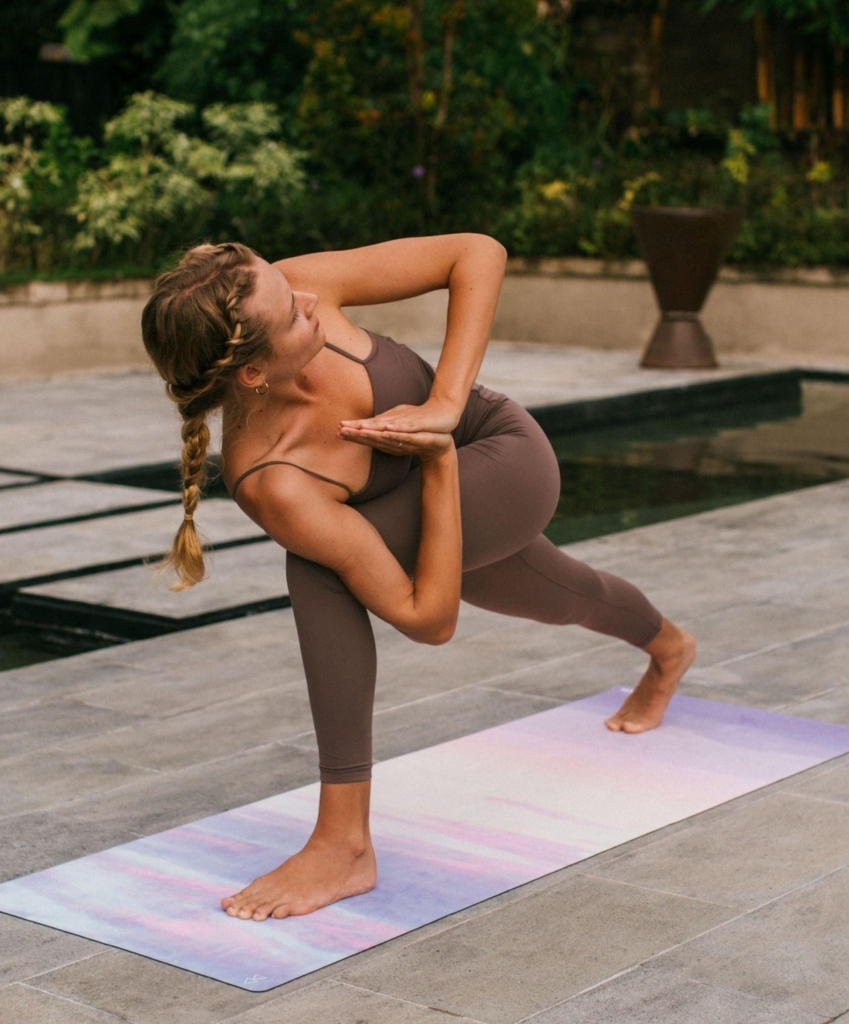
There are a handful of yoga poses that I’d classify as “difficult.” By difficult, I’m referring to the variety of components that must line up to ensure that an individual to have the ability to apply the pose with stability and ease. The checklist of difficult poses consists of numerous yoga’s “fancy” poses similar to Full Pigeon (Eka Pada Raja Kapotasana) and Revolved Crow Pose (Parvrtta Bakasana). These are poses I don’t really feel snug writing about. Studying these poses requires the steerage of an in-person, skilled instructor. As a substitute, I’d like to interrupt down the steps to a comparatively widespread—however difficult—pose: Revolved Aspect Angle Pose (Parvrtta Parsvakonasana).
Parts of Revolved Aspect Angle Pose
Working towards Revolved Aspect Angle Pose requires various vital expertise, and as such, it helps us domesticate these expertise as effectively. Parvrtta Parsvakonasana is a variation on Warrior Poses (Virabhadrasana). So leg energy is essential.
It’s also a difficult balancing pose. There are a number of causes for this. First, it’s very troublesome to floor the heel of the again foot whereas nonetheless preserving the foot going through ahead. So not like the opposite wide-legged standing poses, the again foot can’t as successfully act as an anchor. Additionally, twisting can typically be disorienting, which may problem stability. When paired with energy and stability challenges, including in spinal rotation could be a lot to navigate.
Find out how to Put together for Parvrtta Parsvakonasana
Listed below are a number of poses that may show you how to put together for Revolved Aspect Angle Pose:
- Talasana (Palm Tree Pose): Palm Tree Pose stretches the perimeters of the physique to assist put together for twisting.
- Anjaneyasana (Crescent Lunge Pose): Crescent Lunge stretches the quads and hip flexors. This prepares the physique for Warrior I Pose (Virabhadrasana I).
- Parvrtta Anjaneyasana (Revolved Lunge Pose): As a result of your again knee is grounded, that is principally a extra secure model of Revolved Aspect Angle Pose. It permits you to give attention to twisting with out worrying about dropping stability.
- Virabhadrasana I: Warrior I permits you to discover stability along with your legs in the identical place they’ll be in throughout Parvrtta Parsvakonasana.
These are what I’d take into account to be the important poses to organize your physique for Revolved Aspect Angle Pose. Working towards different wide-legged standing poses similar to Trikonasana (Triangle Pose), Parsvakonasana (Aspect Angle Pose), Parsvottanasana (Pyramid Pose) and Virabhadrasana II (Warrior II Pose) is also useful for warming up your legs and cultivating stability.
When you’re ready, you’ll be able to transfer on to Parvrtta Parsvakonasana.
Find out how to Observe Revolved Aspect Angle Pose
- Stand in Tadasana (Mountain Pose) on one finish of a nonskid yoga mat.
- Place your arms in your hipbones.
- Step your proper foot again 2-3 ft, preserving your ft hips-width aside from left to proper. Don’t attempt to line up your heels. That place is structurally unstable and can solely make balancing rather more troublesome.
- Bend your left knee, shifting into Warrior I, preserving your arms in your hips. You should not have to bend the knee to 90 levels, however do ensure that the knee is immediately over your heel and never in entrance of it.
- Permit your proper heel to carry off the ground.
- Rotate your torso towards your left leg, preserving your torso upright for now. Place your proper hand on the surface of your left thigh.
- As you rotate permit your whole proper leg, together with the pelvis, to rotate towards the left leg.
- Lengthen your torso as you prolong ahead over the left leg.
- Start by putting your proper hand on the surface of your left thigh. Then slowly start to slip the arm down the leg to the purpose the place your respiration turns into restricted. Then again off to the purpose the place you’ll be able to breathe simply. For some folks, putting the elbow on the surface of the alternative knee will permit for deep respiration. For others, it could be extra acceptable to put the hand or forearm on the surface of the thigh.
- In case your elbow is on the surface of the left thigh, place your arms in Anjali Mudra (Prayer Place).
- Regardless that your proper heel is just not on the ground, preserve your proper leg actively extending with the heel reaching down towards the ground.
- Take 5 to 10 deep breaths right here. In case your respiration feels restricted, carry your torso up a bit away out of your left leg.
- To come back out of the pose, carry your torso up, rotate again to the middle, straighten your left knee and step the correct foot ahead—on this order.
- Stand in Tadasana and examine in with what adjustments could have taken place in your physique.
- Repeat on the opposite facet.
About Charlotte Bell
Charlotte Bell found yoga in 1982 and started educating in 1986. Charlotte is the writer of Conscious Yoga, Conscious Life: A Information for On a regular basis Observe and Yoga for Meditators, each revealed by Rodmell Press. Her third guide is titled Hip-Wholesome Asana: The Yoga Practitioner’s Information to Defending the Hips and Avoiding SI Joint Ache (Shambhala Publications). She writes a month-to-month column for CATALYST Journal and serves as editor for Yoga U On-line. Charlotte is a founding board member for GreenTREE Yoga, a non-profit that brings yoga to underserved populations. A lifelong musician, Charlotte performs oboe and English horn within the Salt Lake Symphony and people sextet Purple Rock Rondo, whose DVD gained two Emmy awards.