
 As runners, we regularly chase the clearly rewarding features of our sport — sooner occasions, longer distances, and that exhilarating sense of move on the path. But, there may be one other probably extra essential pursuit: sustaining the effectivity of our our bodies to maintain efficiency and keep away from disruption.
However for a lot of runners, staying wholesome looks like a sport of probability, with durations of blissful, pain-free operating immediately disrupted by ache and damage with out warning.
In actuality, wholesome operating and damage are removed from binary. Quite, they’re at two ends of a continuum. Approaching the damage finish of the spectrum usually begins with delicate indicators that get progressively extra noticeable. The nearer consideration we pay to these small points, the higher we’re in a position to keep away from the damage finish of the continuum altogether.

Taking note of delicate indicators can assist maintain biomechanical dysfunction from turning into an damage. Photograph: iRunFar/Eszter Horanyi
Biomechanical Dysfunction as an Iceberg
Most operating accidents are usually not random. As an alternative, many stem from deep-seated biomechanical dysfunctions. These are conditions the place key physique elements and techniques fail to perform appropriately over time, whether or not attributable to inadequate movement, power, or coordination. This could happen at a micro stage, equivalent to restricted mobility in particular joints or tissues, or at a macro stage, involving whole-scale inefficiencies in stride mechanics, together with posture and propulsion.
Impaired operating efficiency — a lack of prime pace and endurance — is usually the primary signal that one thing is amiss. If untreated, dysfunctions can then manifest as stiffness, soreness, and ache earlier than in the end creating right into a full-blown damage. As such, damage not often strikes with out warning. In truth, it serves as a lagging indicator of diminished system effectivity.
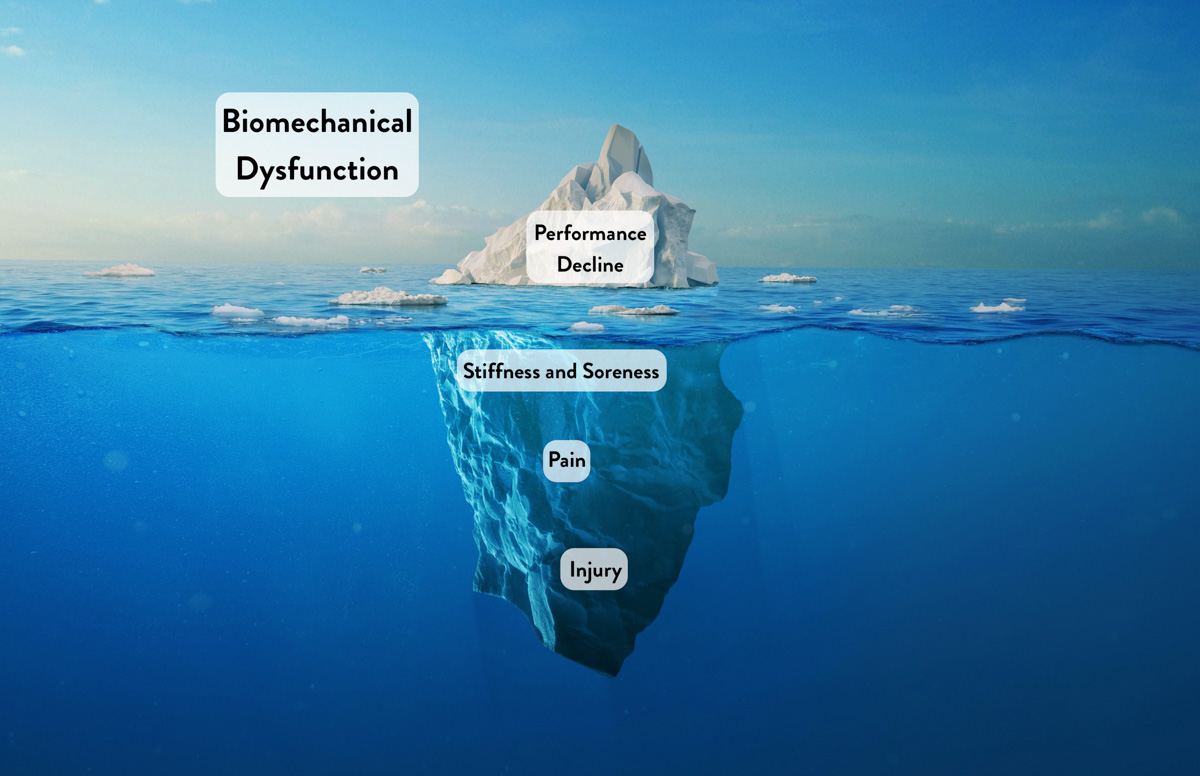
The biomechanical dysfunction iceberg. Picture is modified from Shutterstock.
Consider an rising dysfunction as an iceberg: the majority lies hidden beneath the waterline, with solely the tip readily seen from afar. On this metaphor, the seen tip of the iceberg represents efficiency lower, whereas beneath the water are the bigger and extra insidious problems with stiffness, soreness, ache, and, ultimately, damage.
In a earlier article, we outlined the worth of routine orthopedic upkeep, ideally guided by a trusted skilled — your “household observe orthopedist” — to evaluate, restore, and protect biomechanical effectivity. Nevertheless, not each runner has quick entry to such care. The problem, then, is to proactively monitor your individual system’s well being by monitoring mobility, energy, effectivity, and efficiency throughout a number of metrics to detect — and shortly and successfully reverse — dysfunctions as quickly as attainable.
If we will be taught to acknowledge an rising dysfunction in that monitoring course of by its early warning signal of a lower in efficiency because the tip of an iceberg, then we will steer our ship nicely away from the massive chunk of ice and keep away from severe injury.
So, on this article, we’ll enable you to to grasp our physique techniques as an iceberg, in addition to the corrective motion you’ll be able to take to verify your ship stays in ice-free waters. This technique not solely prevents season-ruining accidents, however it is usually the important thing to more practical coaching with faster restoration, minimal aches and pains, sooner efficiency, and in the end extra pleasurable operating.
Physiological Elements Can Additionally Be Icebergs
Earlier than we, ahem, dive in, we need to point out that not all efficiency declines, aches, pains, and accidents come up strictly from inefficient motion. Different physiological components can be icebergs resulting in efficiency impairment, aches and pains, and damage, together with:
- sleep (amount and high quality)
- vitamin (amount and high quality)
- non-running exercise load (work, household)
- non-physical (emotional and/or psychological) stressors
All of those components can profoundly impair our operating and result in damage, even with pristine biomechanics. Key big-picture metrics to watch holistic well being might embrace sleep measures, in addition to resting coronary heart price and coronary heart price variability.

Even with excellent biomechanics, physiological components can result in points. Photograph: iRunFar/Eszter Horanyi
Layers of the Iceberg
The next are 4 progressive indicators of biomechanical inefficiency, so as of first look and growing severity, from the tip of the iceberg on down. When ignored, delicate indicators of biomechanical dysfunction, like elevated coronary heart price or decreased mobility, may end up in the escalation of a difficulty that results in damage.
Declining Efficiency Metrics
The primary seen layer of a difficulty usually seems in efficiency knowledge. You would possibly discover lowered top-end pace throughout quick sprints or intervals, slower occasions on acquainted runs, loops, or quick races, or elevated coronary heart price and perceived effort for normal paces and distances. This tip of the iceberg may be remarkably delicate, notably if you’re not carefully attuned to your physique’s suggestions or don’t keep constant coaching logs. Many runners overlook these shifts, attributing them to exterior components or just an off day.
Elevated Stiffness and Soreness
The following progressive clues of system inefficiency are elevated stiffness, decreased mobility, and tissue soreness. Stiffness manifests when dynamic stretching feels extra resistant, yoga or mobility routines change into difficult, or day by day transitions — rising from mattress, standing after extended sitting, or the preliminary miles of a run — require prolonged time to really feel fluid and regular. Soreness, in the meantime, displays larger muscle sensitivity throughout stretching, energetic use, or affect loading.
When these intensify regardless of constant quantity, depth, or acquainted coaching progressions, they point out the equal of rising friction in a system. This layer is extra noticeable than declining efficiency metrics, but nonetheless tempts dismissal as non permanent or acceptable, particularly if occurring throughout high-volume, A-race preparation.

Small indicators can point out points lengthy earlier than they flip right into a full damage. Photograph: iRunFar/Eszter Horanyi
Elevated Ache
This subsequent layer down within the iceberg is discomfort past typical soreness that persists throughout or after runs. Because it worsens, ache might start to restrict operating period or depth and ultimately immediate compensation, like limping. Ache usually precedes tissue injury, signaling overload with out essentially indicating breakdown. But.
For many runners, that is usually the purpose at which they lastly notice an issue exists. But they could nonetheless fail to acknowledge operating inefficiency because the trigger, usually blaming different exterior components equivalent to chilly climate, poor footing, or defective or totally different footwear.
Harm
On the frozen backside of the iceberg lies damage, when actual tissue injury happens. This generally is a sprain, pressure, or fracture, and is usually accompanied by swelling, bruising, reasonable to extreme ache, weak spot, and lowered load-bearing capability.
Not attributable to dangerous luck or coaching faults, tissues fail underneath the relentless pressure of an inefficient system over many miles, months, and even years. For instance, an acute hamstring pressure might really feel random or due to operating quick, but the true trigger could also be a chronically anteriorly tilted pelvis that’s inserting extreme stress on one hamstring. Over time, particularly throughout lengthy or quick efforts, this may result in micro or macro muscle tears.

Quick efforts could cause accidents if there are underlying mechanical inefficiencies. Photograph: iRunFar/Eszter Horanyi
Methods to Monitor the Ship and Change Course in Icy Waters
To keep away from ramming headlong right into a season-wrecking iceberg — in addition to discovering the calmest waters for easy, straightforward crusing — prioritize self-assessment and early motion:
- Know Your Optimum Stride. Familiarize your self together with your best operating type, ideally utilizing video evaluation with your loved ones observe orthopedist. Know what your “finest” appears to be like and looks like, and test in routinely.
- Perceive Your Baseline Mobility. Usually test your vary of movement in key areas, just like the hips, ankles, and thoracic backbone.
- Preserve Dependable Working Information. Observe coronary heart price, typical paces adjusted for seasonal health, and efficiency on normal routes. It’s finest to pair these with effort metrics.
- Heed Stiffness, Soreness, and Ache. Have a day by day mobility routine and acknowledge sustained flexibility losses, in addition to elevated soreness and ache, as indicators of elevated stress from lowered effectivity, quite than dangerous luck or random probability.
- Restore What You Can. Self-massage and stretch related areas; carry out routine core and hip energy workout routines; do mobility work on restricted areas; activate core and hip stability; and self-optimize your stride as finest you’ll be able to, till…
- Search Skilled Assist Early. Seek the advice of your trusted household observe orthopedist on the first substantive indicators of an iceberg. Early intervention minimizes downtime, accelerates restoration, helps progressive coaching, and in the end enhances efficiency.
Peak operating well being exists on a continuum — from maximal effectivity with minimal pressure to inefficiency that strains tissues and invitations damage. By deeply understanding your physique, coaching historical past, and typical responses to load, you place your self for sustained, sturdy, quick, and joyful operating. Monitor the iceberg carefully, intervene early and correctly, and steer your ship to its finest course!

Listening to your physique carefully may end up in many lengthy and pleased operating miles. Photograph: iRunFar/Eszter Horanyi
Name for Feedback
- Have you ever ignored the early indicators of biomechanical dysfunction, solely to finish up with an damage?
- What different indicators do you heed to stave off an damage?