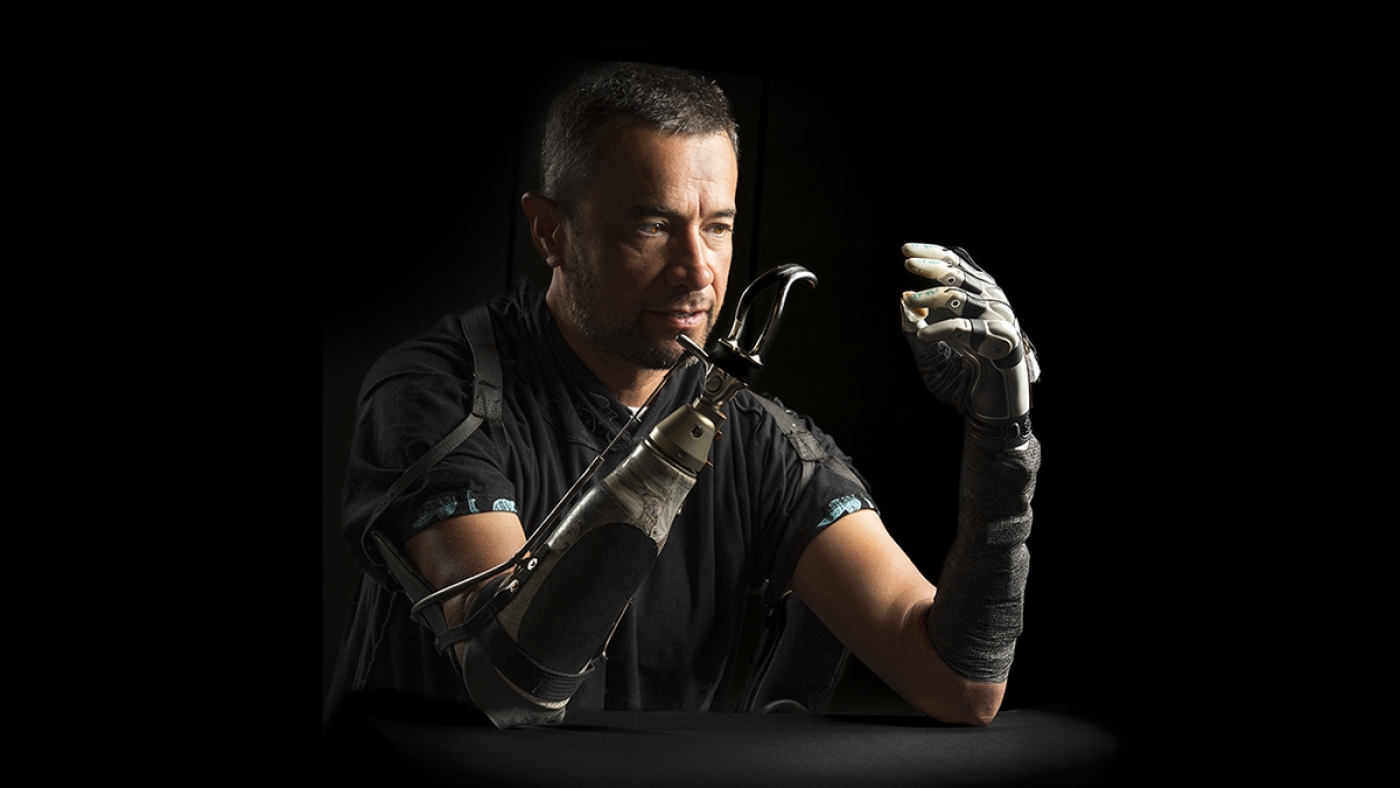

Samoana Matagi was one of many 4 members in a research that examined the capabilities of a brand new bionic hand. Right here, Matagi wears the bionic hand on one arm and a standard prosthetic referred to as a body-powered hook on the opposite.
Dave Titensor/Utah NeuroRobotics Lab
disguise caption
toggle caption
Dave Titensor/Utah NeuroRobotics Lab
Researchers have constructed a prosthetic hand that, with the assistance of synthetic intelligence, can act much more like a pure one.
The bottom line is to have the hand acknowledge when the consumer desires to do one thing, then share management of the motions wanted to finish the duty.

The method, which mixed AI with particular sensors, helped 4 folks lacking a hand simulate ingesting from a cup, says Marshall Trout, a researcher on the College of Utah and the research’s lead creator.
When the sensors and AI have been serving to, the members might “very reliably” grasp a cup and faux to take a sip, Trout says. However with out this shared management of the bionic hand, he says, they “crushed it or dropped it each single time.”
The success, described within the journal Nature Communications, is notable as a result of “the power to exert grasp power is likely one of the issues we actually battle with in prosthetics proper now,” says John Downey, an assistant professor on the College of Chicago, who was not concerned within the analysis.

Issues like that trigger many amputees to develop annoyed with their bionic fingers and cease utilizing them, he says.
A serving to hand
The newest bionic fingers have motors that permit them to swivel, transfer particular person fingers, and manipulate objects. They will additionally detect electrical alerts coming from the muscle groups which are used to manage these actions.
However as bionic fingers have change into extra succesful, they’ve additionally change into tougher for customers to manage, Trout says.

“The particular person has to take a seat there and actually deal with what they’re doing,” he says, “which is admittedly not how an intact hand behaves.”
A pure hand, for instance, requires little or no cognitive effort to hold out routine duties like reaching for an object or tying a shoelace. That is as a result of as soon as an individual places the duty in movement, many of the work is completed by specialised circuits within the mind and backbone that take over.
These circuits permit many duties to be completed effectively and mechanically. Our acutely aware thoughts solely intervenes if, say, a shoelace breaks, or an object is moved unexpectedly.

So Trout and a staff of scientists got down to make a sensible prosthetic that will act extra like an individual’s personal hand.
“I simply know the place my espresso cup is, and my hand will simply naturally squeeze and make contact with it,” he says. “That is what we wished to recreate with this method.”

Utilizing AI and a collection of sensors, researchers outfitted a bionic hand in order that it share management with the mind when appearing on directions.
Dave Titensor/Utah NeuroRobotics Lab
disguise caption
toggle caption
Dave Titensor/Utah NeuroRobotics Lab
The staff turned to AI to tackle a few of these unconscious capabilities. This meant detecting not simply the sign coming from a muscle, however the intention behind it.
For instance, the AI management system realized to detect the tiniest twitch in a muscle that flexes the hand.
“That is when the machine controller kicks on, saying, ‘Oh, I am attempting to know one thing, I am not simply sitting nonetheless,'” Trout says.

To make the method work, the scientists modified a bionic hand by including proximity and strain sensors. That enables the AI system to gauge the space to an object and assess its form.
In the meantime, the strain sensors on the fingertips inform the consumer how firmly their prosthetic hand is holding the item.
Sharing management
The thought of sharing management of a bionic hand addresses a response many individuals have after they use a prosthetic with superhuman talents, says Jacob George, a professor on the College of Utah and director of the Utah NeuroRobotics Lab.

“You can also make a robotic hand that may do duties higher than a human consumer,” he says. “However while you really give that to somebody, they do not prefer it.”
That is as a result of the gadget feels overseas and out of their management, he says.
John Downey says that one purpose we really feel linked to our personal fingers is that they’re managed collectively by our ideas and by reflexes within the mind stem and spinal wire.

Meaning the pondering a part of our mind does not have to fret in regards to the particulars of each movement.
“All of our motor management entails reflexes which are unconscious,” Downey says, “so offering robotic imitations of these reflex loops goes to be necessary.”
George says the good bionic hand solves for that subject.
“The machine is doing one thing and the human is doing one thing, and we’re combining these two collectively,” he says.
That is a vital step towards creating prosthetic limbs that really feel like an extension of the particular person’s personal physique.
“Finally, while you create an embodied robotic hand, it turns into part of that consumer’s expertise, it turns into part of themselves and never only a software,” George says.
Even probably the most superior bionic fingers nonetheless want some assist from a human mind, Downey says.
For instance, an individual can use the identical pure hand to softly thread a needle, then firmly carry up a toddler.
“The dynamic vary on that’s far past what robots usually deal with,” Downey says.
That’s prone to change, as bionic limbs change into more and more versatile and succesful. What will not change, scientists say, is people’ want to retain a way of management over their synthetic appendages.